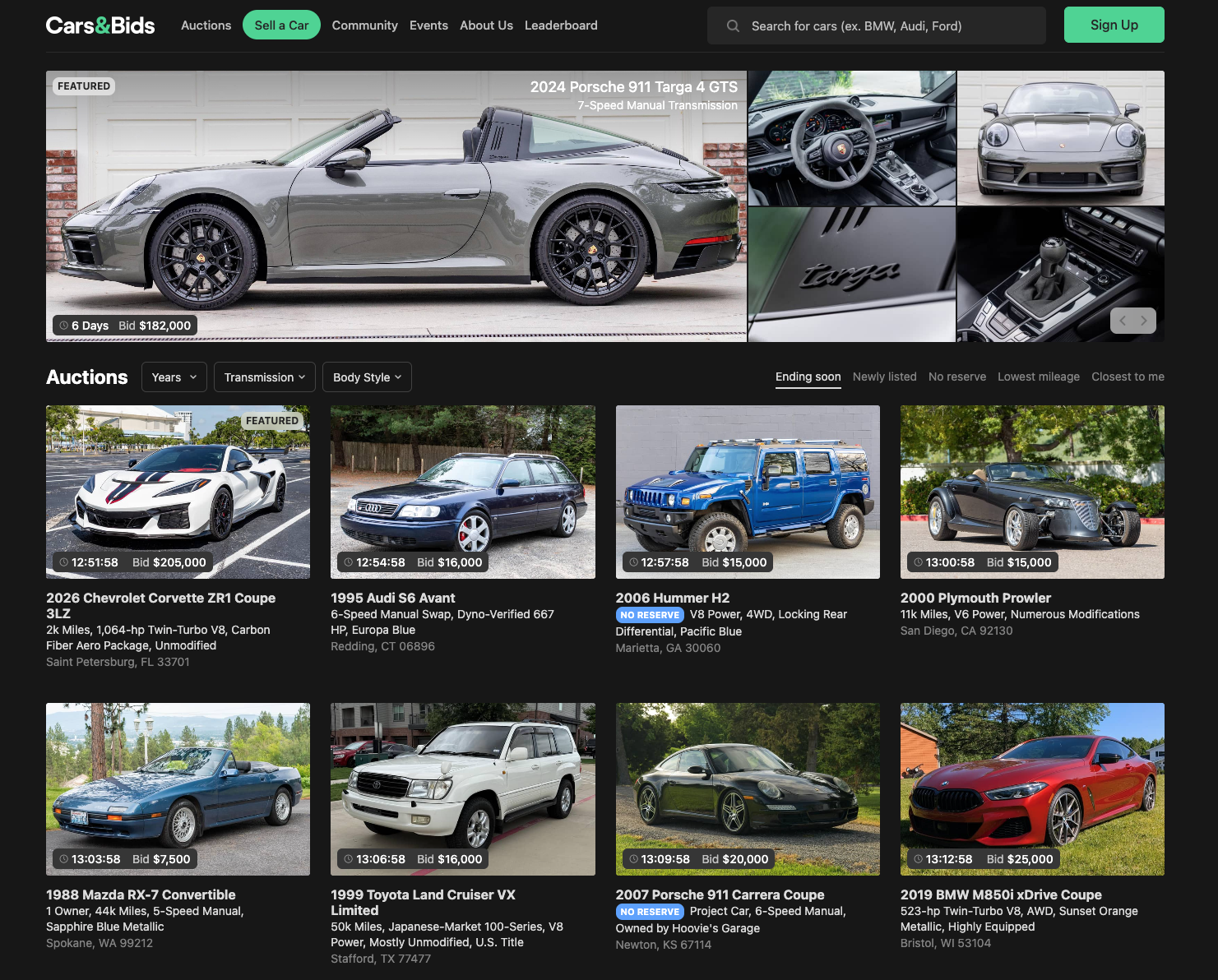
The online car auction market is booming. Bring a Trailer crossed $1 billion in annual sales. Cars and Bids — launched in 2020 by Doug DeMuro — built a loyal audience of enthusiast buyers and sellers within its first year. Behind both platforms is a deceptively straightforward idea: give passionate car buyers a transparent, community-driven place to bid on vehicles, and the market will come to you.
If you are thinking about launching your own car auction website — whether targeting a specific niche like classic cars, exotics, JDM imports, trucks, or off-road vehicles — this guide breaks down exactly what it takes. We will cover the features that make auction platforms work, the real build-vs-buy decision, and how to get your platform live without spending years on custom development.
What Makes Platforms Like Bring a Trailer and Cars & Bids Work
Before building anything, it is worth understanding why the successful platforms in this space actually succeed. It is not primarily the technology — it is the combination of trust, community, and content quality.
- Curated listings: Both BaT and Cars and Bids review and approve every listing before it goes live. This curation filters out low-quality submissions and creates a marketplace where buyers trust that what they see is accurately represented.
- Detailed documentation requirements: Sellers on these platforms provide comprehensive photo galleries, maintenance records, known issues disclosures, and vehicle histories. Transparency is the foundation of bidder confidence.
- Community commentary: The comment section on each auction is a distinguishing feature. Knowledgeable enthusiasts ask questions, share expertise, and flag potential issues — acting as a collective due-diligence layer that makes buyers feel safer bidding remotely.
- Fixed-duration auctions: Most listings run for 7 days with a hard end time. This creates urgency and a predictable cadence that keeps bidders returning regularly.
- Transparent bid history: Every bid is publicly visible in real time. This transparency reduces the "am I getting played?" anxiety that plagues traditional private-party sales.
Your platform does not need to replicate every feature of BaT from day one. But it does need to nail the fundamentals — trustworthy listings, an intuitive bidding interface, and a clear value proposition for both buyers and sellers — before anything else matters.
Core Features Every Car Auction Website Needs
Auction platforms are more technically complex than standard e-commerce sites. The core feature set you will need to launch a functional marketplace includes:
Bidding Engine
The bidding engine is the heart of your platform. It must handle real-time bid submissions, enforce minimum bid increments, prevent bid sniping (or manage it intentionally through countdown extensions), and display the current highest bid accurately to all users simultaneously. This is the component where reliability is non-negotiable — a glitch during a closing auction destroys user trust immediately.
Vehicle Listing System
Sellers need a structured submission flow that captures all the information buyers need: year, make, model, mileage, VIN, location, condition notes, service history, modifications, and a large photo gallery. Many platforms require 50–100 photos per listing as a minimum. Video walk-arounds are increasingly standard. The listing system should include a review queue so your team can approve, edit, or reject submissions before they go public.
User Accounts and Verification
Both buyers and sellers need verified accounts. Bidder verification — typically a credit card hold or identity check — prevents frivolous bids and protects sellers. A reputation system (completed purchases, seller rating, bid history) builds the social trust layer that keeps your marketplace honest over time.
Payment Processing and Fee Collection
Your platform will typically charge a buyer's premium (a percentage of the winning bid), a listing fee, or both. You need secure payment processing for these fees as well as a mechanism for handling deposits. Full vehicle payment is usually handled directly between buyer and seller, but some platforms are moving toward in-platform escrow for higher-value transactions.
Comments and Q&A System
An active comment section per listing is one of the most valuable features you can offer. Buyers use it to ask technical questions, request additional photos, and flag concerns. Sellers build credibility by responding promptly and honestly. The comments section is your community — invest in moderation tools from the start.
Notifications and Watchlist
Bidders need real-time alerts when they are outbid, when an auction they are watching is ending soon, and when new listings match their saved search criteria. Email and push notifications are table stakes. Without them, engagement drops sharply and you will lose bidders to distraction before auctions close.
Admin Dashboard
Your team needs tools to manage the entire operation: approve listings, moderate comments, handle disputes, monitor active auctions, view financial reporting, and manage user accounts. A well-designed admin backend is the operational backbone of your platform — underinvesting here creates operational bottlenecks as you scale.
Build From Scratch vs Ready-Made Auction Software

This is the most consequential decision you will make before launching. Both paths are valid — but they have very different implications for cost, timeline, and risk.
Building From Scratch
Custom development makes sense when your auction model has genuinely unique requirements that no existing platform can accommodate, or when you are building for institutional scale from day one and need full technical ownership. The advantages are complete control and no dependency on a third-party vendor. The disadvantages are cost, timeline, technical risk, and ongoing maintenance overhead. Most entrepreneurs launching their first auction platform underestimate all four.
Ready-Made Auction Software With Customization
The smarter path for most founders and businesses is starting with a proven auction software platform and customizing it to fit their niche and brand. You get battle-tested bidding infrastructure, a feature set that would take years to replicate from scratch, and a fraction of the upfront cost — with the flexibility to tailor the experience to your specific market.
This is the same approach used by many successful niche marketplaces: start with solid underlying software, differentiate through your category focus, your curation standards, your community, and your marketing — not by reinventing the bidding engine.
Premium Auction Software: Ready-Made Platform, Fully Customizable
If you want to launch a car auction website without spending a year and a six-figure budget on custom development, Premium Auction Software is one of the most capable ready-made solutions available. The platform is purpose-built for running competitive online auctions and comes equipped with the core infrastructure a vehicle marketplace needs out of the box.
What the platform brings to the table:
- Real-time bidding engine: Handles live bid submissions, automatic bid increments, timed auction countdowns, and outbid notifications — the technical foundation of any auction platform, already built and tested.
- Flexible listing management: Sellers can submit listings with photos, descriptions, and custom fields. You can configure your own required fields (VIN, mileage, condition, service records) to match the documentation standards your platform demands.
- Buyer and seller accounts: Full user account management with registration, verification workflows, bid history, and seller profiles built in.
- Fee and payment configuration: Set your own buyer's premium percentage, listing fees, and reserve price rules. The platform handles fee calculation automatically at auction close.
- Admin and moderation tools: A comprehensive backend for managing listings, users, active auctions, and financials — giving your team the operational controls needed to run a curated marketplace.
- Mobile-responsive design: The platform is built for mobile from the ground up, which matters because a large percentage of auction bidding happens on phones during the final hours of a listing.
Crucially, the platform also offers full customization services — meaning you are not locked into a generic template. You can have the platform skinned to your brand, extended with niche-specific features (vehicle inspection integrations, transport quote calculators, specialist category filters), and configured to match the exact workflow you envision for your marketplace. This combination of ready-made reliability and custom flexibility is what makes it a strong starting point for car auction entrepreneurs who want to move fast without cutting corners.
Technical Considerations You Cannot Ignore
Whether you build or buy, several technical factors will determine whether your platform holds up under real traffic and real bidding activity:
- Real-time performance under load: The final minutes of a closing auction generate a spike in simultaneous bids and page refreshes. Your infrastructure needs to handle this without slowing down or dropping connections. WebSockets or server-sent events for real-time updates are standard approaches.
- Anti-sniping logic: Decide upfront whether you want to extend auctions automatically when a bid is placed in the final minutes (as BaT does). This encourages fair price discovery but makes exact end times unpredictable. Document your policy clearly for users.
- Image storage and delivery: Car listings with 50–100 high-resolution photos generate significant storage and bandwidth requirements. A CDN (content delivery network) is not optional — it is infrastructure. Plan for this in your hosting budget from day one.
- Search and filtering: Buyers need to filter by make, model, year range, mileage, location, price range, and auction status. A fast, reliable search layer is critical for user experience — slow search results kill browsing sessions.
- SEO architecture: Each listing page is an SEO opportunity. Well-structured URLs, proper meta tags, and schema markup for auction listings help your platform show up when people search for specific vehicles. This compounds significantly over time as your listing archive grows. See our guide on technical SEO fundamentals for implementation guidance.
Designing for Trust and Conversions
An auction marketplace is fundamentally a trust business. Buyers are committing to purchase vehicles they have only seen in photos, often from sellers they have never met, for amounts ranging from a few thousand to hundreds of thousands of dollars. Every design decision should reinforce trust and reduce perceived risk.
Design principles that matter specifically for auction platforms:
- Transparent bid history: Show every bid publicly, in real time, with timestamps. Hidden or manipulated bid histories are one of the fastest ways to destroy a marketplace's reputation.
- Verified seller badges: Visual indicators that a seller's identity has been confirmed and that they have a track record of completed sales reduce buyer hesitation significantly.
- No-reserve labeling: Clearly identify no-reserve auctions — listings where the highest bid wins regardless of price — since these consistently attract more early bidding activity and higher final prices.
- Clear terms at checkout: Spell out exactly what happens after an auction closes: who contacts whom, within what timeframe, what the payment process looks like, and what the dispute resolution path is. Ambiguity here generates support tickets and refund requests.
- Photo quality standards: Set minimum photo requirements and provide guidance to sellers on what to photograph. Consistent, high-quality imagery across listings elevates the perceived quality of your entire platform. See our UX design principles guide for broader guidance on building interfaces that convert.
Launching and Growing Your Car Auction Platform
A marketplace has a chicken-and-egg problem: buyers do not come without inventory, and sellers do not list without buyers. Your launch strategy needs to address both sides simultaneously.
Proven approaches for marketplace bootstrapping:
- Seed your own inventory first: Before launch, curate 20–30 high-quality vehicle listings yourself — sourcing them from your network, consignment deals, or paid partnerships with dealers and collectors. A launch with strong inventory gives buyers a reason to register immediately.
- Target a tight niche first: Rather than competing with BaT on breadth, own a specific category deeply. Air-cooled Porsches, Japanese domestic market imports, pre-war classics, lifted trucks — a focused niche builds an enthusiast community faster than a generic "all vehicles" approach.
- Build the community before the platform: Start a newsletter, YouTube channel, or social media presence around your niche before your platform launches. An engaged audience of 5,000 followers is worth more at launch than any paid advertising campaign.
- Offer free listings initially: Remove friction for early sellers completely. Free listing periods help you build inventory depth while you work on growing the buyer side. Introduce fees once the marketplace has demonstrable demand.
- Publish results publicly: Every completed sale is a proof point. Publish sold prices, highlight interesting vehicles that went through your platform, and share notable auction stories. This content drives SEO, builds credibility, and gives future sellers evidence that your platform moves cars at fair market value.
Building a car auction website is a significant undertaking — but the market opportunity is real, the successful platforms have proven the model, and the path from idea to launch is far shorter today than it was even five years ago. Starting with a capable, customizable platform like Premium Auction Software lets you focus your energy on what actually differentiates your marketplace: the vehicles you curate, the community you build, and the trust you earn with every auction. If you need help with the digital marketing, SEO strategy, or web presence around your auction platform, reach out to our team — we work with marketplace businesses at every stage of growth.